
Category Archives: Product Management

If I had a hammer

Comedian Kathleen Madigan has a routine where she describes the objects that a single woman has in her household toolbox. As you might imagine (since it’s a comedy routine) there’s nothing in the toolbox used for the purpose it was orginally designed. The “hammer,” for example, is a man’s shoe.

This might be humorous to many people but to my product manager sensibilities Madigan’s comedy routine is closer to a horror show… like the scene in Psycho where Anthony Perkins cuts short Janet Leigh’s shower. (eeet!..eet!..eeet!!)

I’m quite sure that some commission-oriented salesman thought it was, well, “okay” to sell a shoe for a purpose it wasn’t designed. In product speak – the salesman sold the product outside of its target market segment.

What’s wrong with selling outside the target market segment?
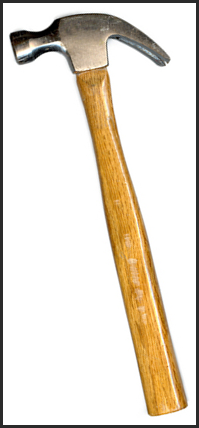
hammer2
Selling to consumers who intend to use a product in ways it wasn’t intended to be used creates a very scary scene.

Let’s fast forward to a client conference where shoe consumers attend a voice-of-the-customer session to provide feedback on which features should be modified or added. So, what does the toolbox owner request for new product features for her “hammer”? New leathers, or colors or perhaps softer soles? Unfortunately, no.

She feels that her product needs a handle so it would be easier to grasp… a metal insert on the heel so it would drive the nail with more force… and the laces should be removed completely since they don’t have any function. Of course, all this makes complete sense because she is using the product outside the segment for which it was designed.

There are very good reasons why markets are segmented in product management. Customer market segments define product features which in turn drives the product design for that segment.

All products are designed for a specific target market – a specific set of users who have similar product requirements and who use the product in a similar manner. Selling a product outside of the defined segment boundaries is dangerous… and is guaranteed to create a horror scene for product managers. (eeet!…eet!…eeet!)

In today’s Economy… is “Tactical” more important than “Strategic?”

Are companies delaying strategic product investments (i.e., where product returns are realized in future years) for investments that provide returns in 2009?

Tom Nicholas from the Harvard Business School published in The McKinsey Quarterly an article which says that executives who take a “wait and see” approach to innovation investment during downturns may be putting their firms at a competitive disadvantage. “Companies that delay these investments may forego significant growth opportunities when uncertainty subsides and the economy recovers.”

In the 1930’s, DuPont R&D produced synthetic rubber and nylon. Radio Corporation of America (RCA) focused on a new technology called Television… And Hewlett Packard and Polaroid were start-ups back then.

The lessons on innovation investment in downturns is very pertinent today. The market will improve and those firms that continue to invest strategically in the down economic cycle will likely see a product advantage over competitors once the cycle improves.

So, are strategic investments taking a back seat during this downturn?

Innovation ROI: What’s YOUR best practice for little “i”?

Extending features of existing products (that is… little “i”) versus big “I” (new product innovation), has gotten a lot of debate on the best way to prioritize product requirements.

Let’s face it… the features that often move to the top are those that the most profitable customer needs or what the CEO thinks is important. In many cases, legacy product request prioritization is not scientific. But should it be?

If this was a perfect world, how should a good product manager prioritize features in a release? Do you segment and rank benefits that are closest in congruence with long term business strategy…. those that return the most profit over the near term… those that are easiest to develop… etc.?

It seems everyone has their own approach… their own “best practice.” It seems most product managers assign attributes to each feature. Examples of these include:

* Build customer loyalty
* Create competitive advantage
* Further business strategy
* …and, of course, the near term financial contribution (more revenue, lower cost, etc)

Aligning each feature request to a list of attributes is vital. As business cycles change, so does product investment. In a down cycle, for example, management may want to advance features that provide revenue sooner versus investing in features that return value further out.

Most product managers that I speak with assign a weighting to each benefit on a scale of 1-10 based on the stakeholder voting. They then calculate a weighted sum score of all the benefits in a release to get to a “Total Return.”

Then they assign a cost value to implement the “Investment” in the release again on a scale of 1-10. Dividing the “Total Return” by “Investment” will give a simple (real simple) ROI Metric for the release. The goal is to craft a portfolio of features that best meets the needs of the stakeholders.

You can then use it to prioritize the features and get a straightforward structured method to prioritize the features in each release. This type of a methodology is much more repeatable and defensible than ad-hoc judgments often used to prioritize requirements and features.

Obviously, the trick is to get the stakeholders to value the various features similarly. Value agreement isn’t expected to be exact, but outliers can be a problem. For example, the client user committee may value highest those features that give more immediate operational relief (i.e., short-term focused), the sales reps may value the features that they have already promised to their sales prospects (i.e., whatever generates new sales in the next quarter), and the marketing team may value highest those features that improves competitive advantage in that new market segment that have been promoting.

Consensus? I think not.

Years ago, a mentor told me that being a product manager is about balance. And she was right. All stakeholders are right… all the time. Disagreements in feature value assignment is largely due to perspective. Like skiing on ice, its all about negotiating the bumps and achieving perfect balance.